
Letters as Eavesdropping
Rules for the sea, love, and writing

Dear Friends,
My third book of poems, If You Love That Lady, is out now from W. W. Norton.
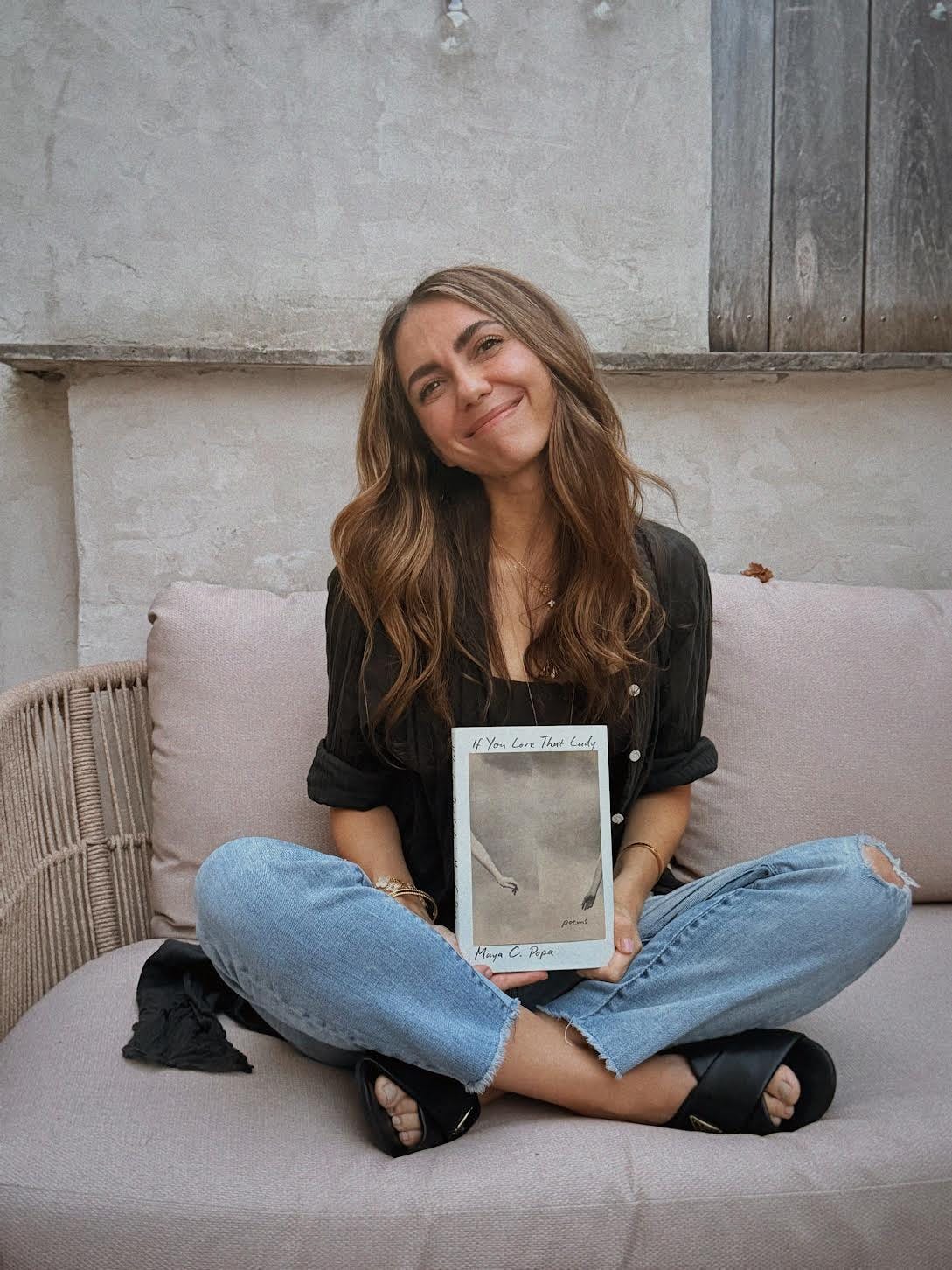
If you happen to be based in New York City, the official launch for If You Love That Lady will take place at The Corner Bookstore on 93rd Street and Madison Avenue on Monday, July 20, at 6:00 p.m. This tiny neighborhood bookstore is a true gem, and they’ve hosted the launch of all three of my books. I would absolutely love to see you there! There will be a reading and Q&A, as well as a chance to mingle with other writers and lovers of poetry.
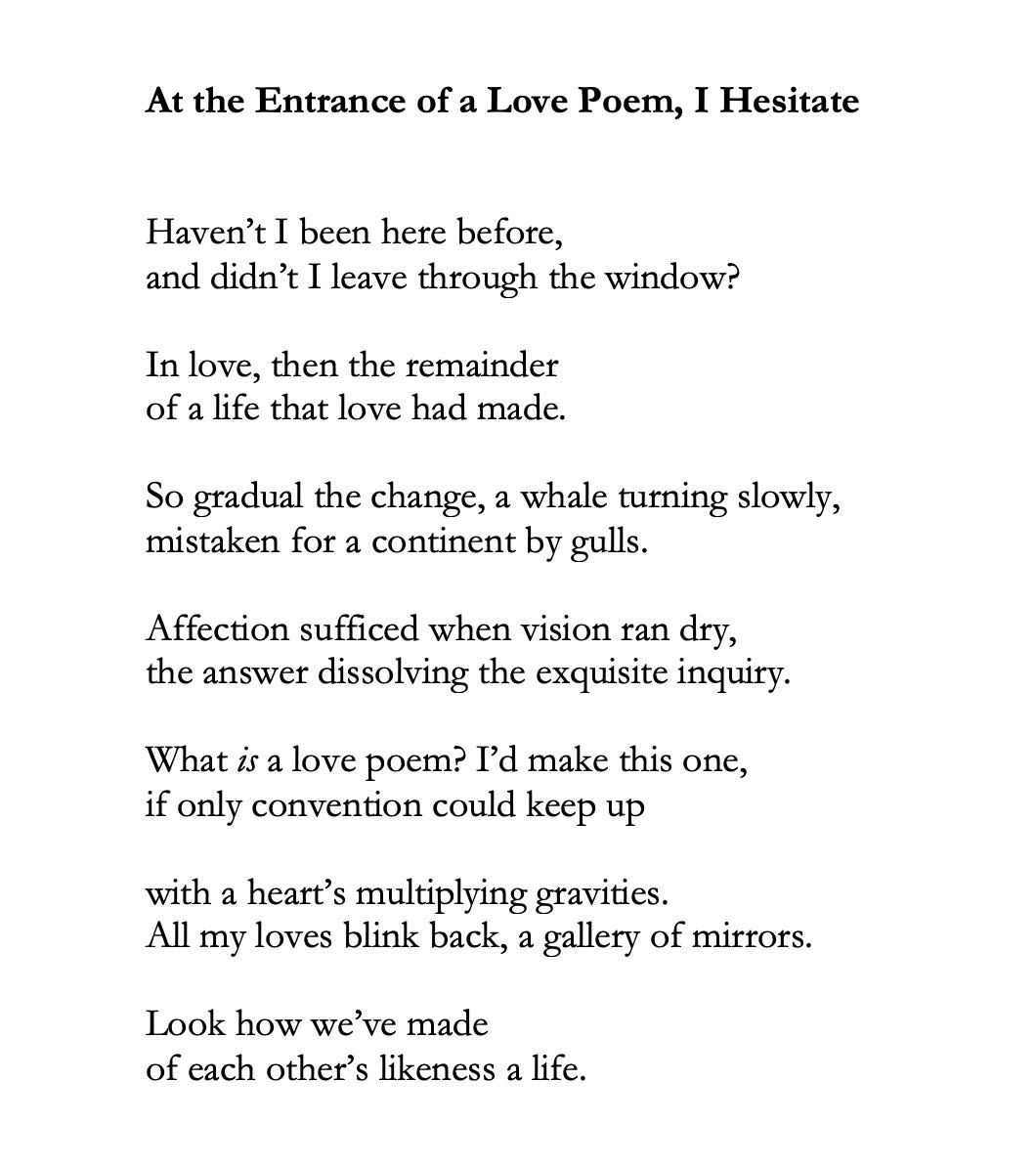
Today, I wanted to share an excerpt from a conversation I had with the wonderful poet Elizabeth Metzger for The Los Angeles Review of Books. I've also included the poems we discussed in the interview whenever they're referenced.
Whether you read the book or not, I hope these questions and answers lead you toward other writers and ideas, and that they prove useful in your own writing practice. That's always front of mind for me in interviews—how can I answer this question in a way that isn't so particular or idiosyncratic that it ceases to be useful to someone else? How can I make it less about me and more about writing itself?
I hope you come away having learned something new.
ELIZABETH METZGER: The title of your new collection takes its source from Robert Graves, as we see in the epigraph, but it also becomes a recurring title throughout. Is repetition the truest form of certainty, truer than any answer? There are many other ways in which repetition contributes to the music of this collection. In “One Way or Another,” you use an almost palindromic form. Can you talk about how you think about form, both its purpose and how it figures in your process?
MAYA C. POPA: I stand by Robert Creeley’s adage about form being an extension of content. Certain subjects seem to naturally reach for shapes familiar to the reader’s eye and ear. If we believe Creeley’s thesis, then there’s something inevitable about form. “One Way or Another” opens with a paraphrase of Heraclitus (“you cannot step into the same river twice”), which is fitting for the shape the poem ended up assuming, a little like a snake swallowing its own tail. That palindromic form wasn’t planned outright. Halfway in, I realized there was nothing left to do but double back on what I’d said already. It was pleasing to recognize it immediately, because there’s very little that’s immediate about my writing process. More often, I am toggling between intuition and acumen, or inspiration and revision, back and forth, until the poem reveals itself enough to pursue a single possibility confidently. This was one of the rare instances where that possibility announced itself outright.
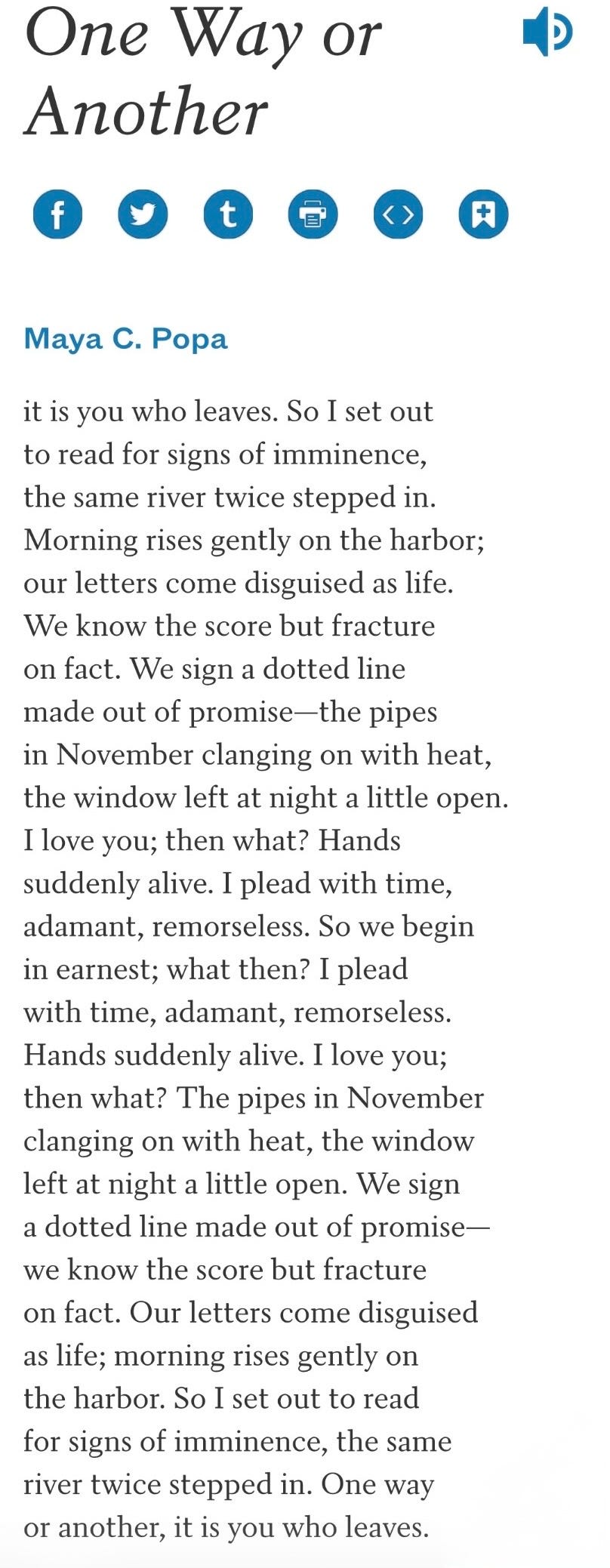
Poems are uniquely fitted to capture internal negotiations and reckoning by making them visually (and sonically) apparent. Through repetition and reversal, you can see just what’s been said and intuit why it has to be said again. That why, the poem’s engine, also becomes its emotional center.
This is a book of thresholds, a place where possibilities often meet impossibilities. The first poem, in fact, begins with a “hesitation.” Is there something about engaging with letters, an antiquated written form, that invites hesitation, or a different approach to boundaries of time and space? Does the epistolary form change your relationship to the lyric?
I once wrote an essay about my many floppy disks of saved AOL Instant Messenger (AIM) conversations. I credit the hundreds of hours I spent agonizing over the tone of my “away messages” (a performance of “away,” since most of the time, we were parked right there watching people enter and leave the chat) with my development as a writer.
That’s where my sense of what it means to have a voice on the page originated, between the hours of 8:00 and 10:00 p.m. with friends and acquaintances. Those AIM conversations existed slightly outside of time—often you’d return to school or camp the next day only to find the intimacies exchanged didn’t translate to a new reality beyond that consuming correspondence.
So, the epistolary form has fascinated me. Reading letters feels—indeed is—a form of eavesdropping (a sensibility at the heart of lyric poetry). A letter offers a remarkably intimate sense of who these individuals were, which naturally includes how they expressed doubt and hesitation.
In the case of Sally McDowell [the ex-wife of the former governor of Baltimore] and John Miller [a pastor], their letters begin in 1854 with her refusal of his offer of marriage. Imagine starting a correspondence there! We know that, by the end of the tome (the collected letters amount to 944 pages over two years), they will end up together. But, as is true of poetry, it’s not what a poem means but how it means that leaves an impact. Their candor and their wit, their mundane recounting and surprises—I found the voice they built together, their how, gripping and affecting, as well as historically complicated (right on the advent of the Civil War).
Miller said something I’ll never forget in those early letters after McDowell’s refusal: that when two ships collide at sea, they should remain in touch, until the extent of the damage is determined. That was at the back of my mind the whole time I wrote the collection. That people should remain close until the extent of the damage is determined. I interpret “damage” loosely—I am most interested in how people are transformed by coming into each other’s lives, and in how chance meetings shape our paths. That seems to me to be one of the chief promises of being alive.
Numerous geographical places are named in this collection (Gunpowder Falls, the Sandwich Islands). Elizabeth Bishop would swoon. Do you see the speaker(s) of these poems as distinctly American? Or what is her relationship to geography?
It’s a fantastic question, and I’m not sure myself how I feel about any of it. On the one hand, I’m undeniably American—I was born and raised in New York. On the other, my first language is Romanian, which is the language I speak at home, and I attended a French school until I was 14. Which means that, for a portion of my life, most of my education had taken place in and through the French language, though I never felt culturally French. My graduate degrees were both in the UK, whose green relief feels closer to me than many American landscapes do. I don’t mean this to sound like unnecessary collegiate cataloging—I just mean that the languages and spaces that have shaped me have not always belonged to America, even though I am American.
I’ve seen more of the United States in the last five years than I had in my entire life prior. As is clear to anyone who has traveled the US widely, there are such regional differences that it can feel like many small nation-states within an impossibly large geography. So the spirit of place matters deeply to me and to the poem’s speaker, but it’s rarely from the point of view of holding an allegiance. In poems like “You Are Here,” there’s real skepticism, a sense of “was it for this?” that I try to situate in my own understanding of belonging to a country that surprises me the moment I experience it in practice rather than in theory.
If you would like to read the whole conversation, you can do so here.
With love and gratitude for the kindness and support you've shown me around the book’s arrival.
xM
“how people are transformed by coming into each other’s lives, and … how chance meetings shape our paths… seems to me to be one of the chief promises of being alive.” Congratulations Maya, enjoy your book’s launch moment. Thank you for the transformations!
This is such a great conversation and I will go to the link to continue reading it. I wanted to say here that I love this line from McDowell.....
"Miller said something I’ll never forget in those early letters after McDowell’s refusal: that when two ships collide at sea, they should remain in touch, until the extent of the damage is determined."
This comforts me and inspires me to write, with this perspective in mind, about a hard relationship journey I've been in for going on 18 years........ thank you!